
Saranghaeyo vs Saranghamnida: Say I Love You in Korean
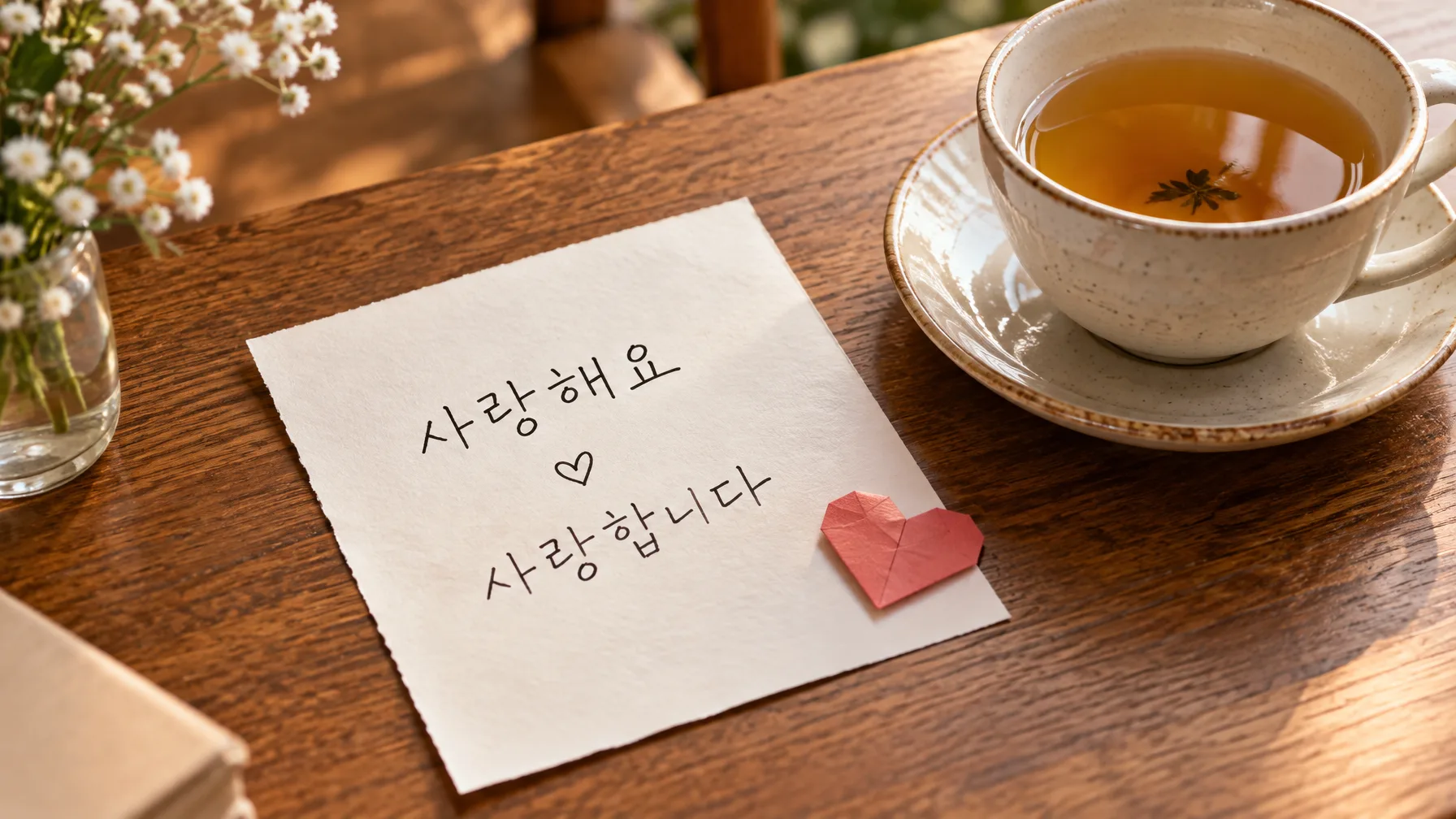 AI-generated image
Say saranghaeyo (사랑해요), the more polite form, when you're unsure how close you are or aren't very close yet. Save saranghamnida (사랑합니다), the most formal form, for public speeches, songs, or showing deep respect. Below you'll find the Hangul, the romanization, the formality levels, and a few softer ways to show affection.
Saranghaeyo is the polite pick when you can't tell how close you are
 AI-generated image
Saranghaeyo (사랑해요 in Hangul) is the polite version of the plain saranghae, and the ending -yo is what softens it. That softer tone is exactly why it works as a starting point.
Think of it as the form that doesn't assume too much. It won't sound too familiar when the distance in a relationship is unclear, and a beginner can say it with confidence because it asks for no deep read of the relationship.
Saranghamnida is the formal one you hear from stages and in songs
 AI-generated image
The -mnida ending in saranghamnida (사랑합니다) is the formal register that Korean uses for announcements and speeches, which is why it reads as the most formal, honorific option.
You will run into it often in pop culture. Entertainers use it when they talk to their fans, and it turns up regularly in song lyrics. When you hear it, the phrase sounds grand and a little ceremonial.
Choose your phrase in four quick steps
 AI-generated image
- Ask yourself how close you really are to the person. 2. If you're unsure, or the two of you aren't very close yet, go with saranghaeyo. 3. If you're giving a speech, singing, or showing deep respect, use saranghamnida. 4.
| Situation | Say | Hangul |
|---|---|---|
| Unsure how close you are, or not yet close | saranghaeyo | 사랑해요 |
| Speeches, songs, deep respect | saranghamnida | 사랑합니다 |
| Informally missing someone | bogo sipeo | 보고 싶어 |
| A lighter "I like you a lot" | neomu joahae | 너무 좋아해 |
Keep that table handy as a cheat sheet. It sorts the four phrases by the moment you're in, which is easier to remember than a list of grammar endings.
In Korean, I love you is a big declaration, especially between couples
Korean culture tends to be more restrained than Western culture about putting love into words. So the phrase carries more weight than a casual "love ya" might in English. Between couples it is a meaningful declaration, not a daily sign-off.
Knowing the grammar is only half of it for a learner. The other half is knowing that the words themselves are heavy, so a polite ending doesn't make them light.
Saying saranghae too often can make it sound hollow
The most common stumble is overuse. In Korean culture, repeating saranghae too often can make it feel insincere. A phrase that carries this much weight loses it when it's handed out all the time.
The second stumble is aiming it at someone you aren't close to. Because saranghae is such a heavy declaration between couples, it may not suit someone you know less well. If you feel the pull to say it to a casual friend, a softer phrase is the better tool.
Bogo sipeo and neomu joahae cover the lighter moments
Both let you show warmth without making a declaration. Bogo sipeo suits a friend or partner you haven't seen in a while. Neomu joahae works when you're fond of someone or something and want to say so clearly but lightly.
Words aren't the only way love gets said in Korea
No phrase list is a rulebook. In Korea, love is often shown through actions more than words, so saying it aloud isn't always the natural move. Sometimes the caring thing is to do something for the person rather than announce a feeling.
Korean greetings and thank-yous follow the same formality logic. If that pattern is new to you, see Basic Korean Words: Formal vs Informal Hello, Thank You and Sorry. It shows how the polite and casual forms compare.
The verdict: default to saranghaeyo, keep saranghamnida for big moments
Beyond those two, bogo sipeo and neomu joahae are there for lighter moments. Say it when you mean it, and it will land well.
Comments
No comments yet.