
Basic Korean Words: Formal vs Informal Hello, Thank You and Sorry
 AI-generated image
Basic Korean words come in formal and informal pairs. Yes is ne in any setting, and no is aniyo, which becomes ani when you want it very casual. Below you'll find a one-glance cheat sheet, a short reason why Korean keeps two versions, a phrase for admitting you only speak a little Korean, and a list of English-looking words that trip people up.
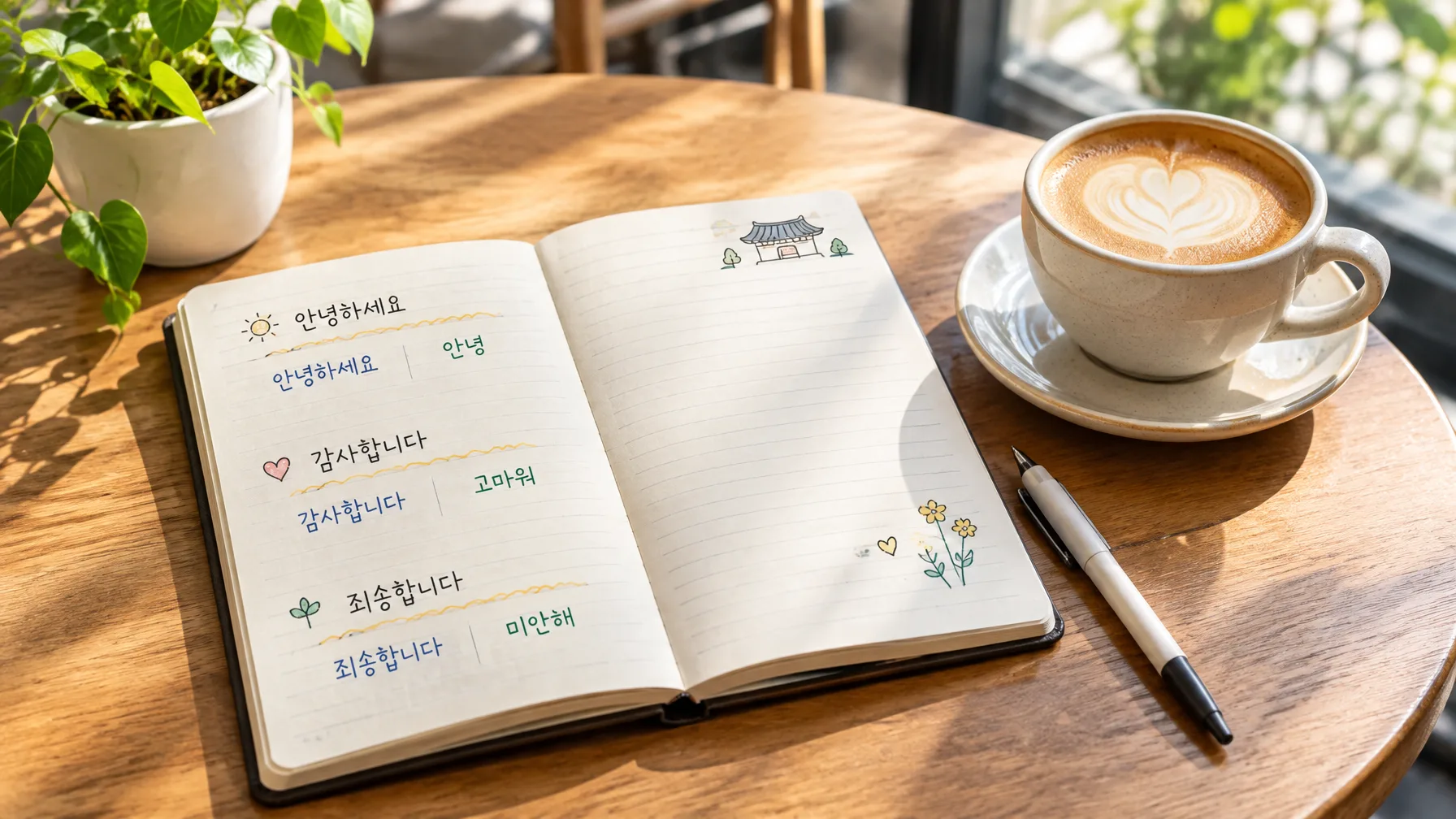
Formal annyeonghaseyo, gomapseumnida and joesonghamnida pair with casual annyeong, gomawo and mianhae
 AI-generated image
| Meaning | Formal (safe almost anywhere) | Informal (friends, casual settings) |
|---|---|---|
| Hello | 안녕하세요 (annyeonghaseyo) | 안녕 (annyeong) |
| Yes | 네 (ne) | 네 (ne); 응 (eung) to someone younger |
| No | 아니요 (aniyo) | 아니요 (aniyo), or very casual 아니 (ani) |
| Thank you | 고맙습니다 (gomapseumnida) | 고마워 (gomawo) |
| I'm sorry | 죄송합니다 (joesonghamnida) | 미안해 (mianhae) |
Think of Korean formal vs informal as two columns of the same word list. If you memorize only one column, make it the left one. Formal words are the ones you can say to a shopkeeper, a hotel clerk or a stranger without worrying about tone. The right-hand column is for friends and relaxed moments. It can sound oddly familiar if you use it on the wrong person.
Why a second, casual twin exists for most beginner words
 AI-generated image
Korean uses different word forms depending on who you are talking to and how formal the moment is. That is why a beginner word list looks doubled. When you're unsure, lean on the formal form. The casual form is a reward you earn once the relationship is relaxed.
A few names are useful early. The Korean language is hangugeo (한국어), and South Korea is daehan minguk (대한민국). Over 50% of Korean vocabulary is rooted in Chinese characters, which is one reason many words feel unfamiliar to English speakers at first.
Here are four more basic Korean words, with their meanings, that show up in beginner lists:
- hada (하다): to do
- utda (웃다): to laugh
- nyeon (년): year
- si (시): hour
Hada is worth noticing, because many Korean verbs are built by attaching it to a noun. Sarang (love) plus hada becomes saranghada, to love. Adjectives behave like verbs too, so "big" is really "to be big." And small particles such as e (에) mark time, place or the destination you are going to. A particle has no meaning on its own.
How to say hello in Korean, and the goodbye that goes with it
 AI-generated image
Hello is the first word you will use, so it is worth getting the sound right. Say annyeonghaseyo (안녕하세요) slowly in beats: ahn-nyong-ha-se-yo. The short version, annyeong (안녕), is the one for people you already know well.
Goodbye is a separate phrase rather than the same word reused. Beginner guides spell it ahn-nyong-hee ga-se-yo (안녕히 가세요). Learning it alongside hello gives you a complete way to walk into a shop and back out again.
Yes and no: ne, eung, aniyo and ani
Yes is the easy one, because ne (네) does not change with the setting. There is also eung (응), which you can use with someone younger than you. As a beginner you can skip eung entirely and nobody will mind.
For no, aniyo (아니요) fits every situation. The casual version is made by dropping the final yo, which leaves ani (아니). Trimming the ending is a handy picture of how casual speech works. It is the same word, just with less polite padding.
Thank you and I'm sorry: where the -mnida endings come in
If you are wondering how to say thank you in Korean, you will actually hear two formal versions. Gomapseumnida (고맙습니다) is the one in the cheat sheet. Kamsahamnida (감사합니다) is just as widely known. Some guides write it as gahm-sah-hahm-ni-da, so don't be thrown when you hear it.
Notice a pattern. The formal thank-you and the formal sorry both end in -mnida, while the casual ones end in -wo and -hae. Once your ear catches that ending, you can tell at a glance which register a word belongs to.
A polite way to admit you only speak a little Korean
Sooner or later someone will answer you in fast Korean.
It also ends in -mnida, so it is already in the polite register. A sentence like this is long for a first week, but it is worth saying aloud several times in a row until it flows. People usually respond warmly when a beginner tries.
Konglish words that look English but mean something else
Korean has borrowed many words from English, and it is tempting to treat them as free vocabulary. The catch is that they must be said the Korean way, so they can be harder to pronounce than you expect. Some Konglish words also shift meaning, so Korean words in English dictionaries do not always line up neatly.
- haendeupon (핸드폰): a cell phone, not a "handphone" in the English sense
- selka (셀카): a selfie
- seobiseu (서비스): free food or drink, not customer service
The service one is the most useful to know. If a server brings you something extra and calls it seobiseu, that is a freebie, and a thank-you is the right reply. Once you spot the pattern, Konglish words become fun to collect.
Start with the five polite words and loosen up later
Start with the formal forms: annyeonghaseyo, ne, aniyo, gomapseumnida and joesonghamnida. They work almost anywhere. Use annyeong, gomawo and mianhae only in casual situations, such as with friends.
Say them out loud a few times today.
Comments
No comments yet.