
Korean Vowels: The 10 Basic Letters and 11 Combined Ones
 AI-generated image
Korean vowels come in two sets: 10 basic letters and 11 combined ones built from them. Several of the combined ones, like ㅐ and ㅔ, sound the same in modern Korean, so the total is far less scary than it looks for beginners. Below are the ten basic letters and the logic behind their shapes, then the eleven sorted by sound, with rough English matches and their limits, the common trouble spots, and how a vowel sits in a syllable block.
Ten basic vowels, eleven combined ones, and a few that sound identical
 AI-generated image
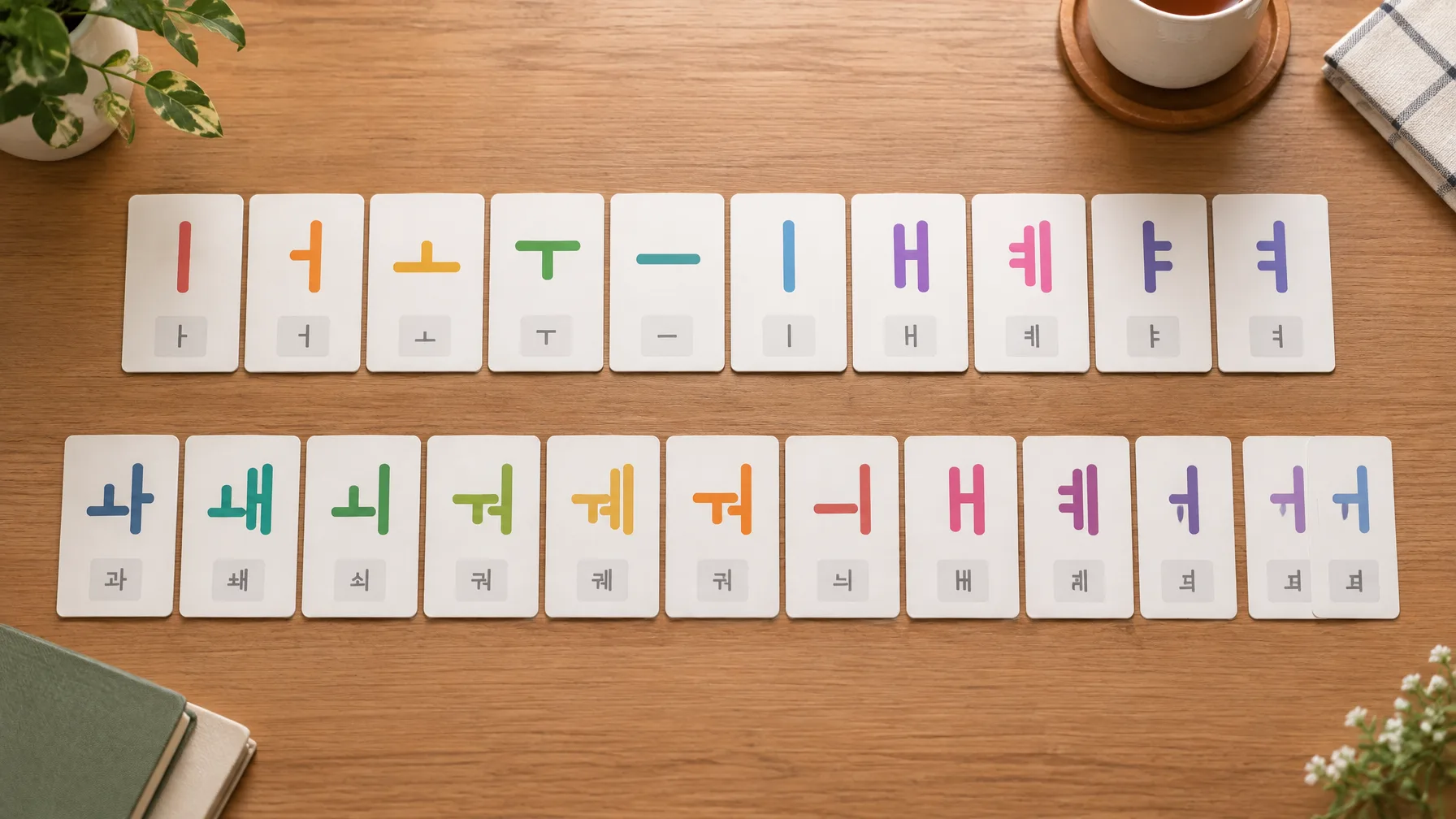
Hangul has 24 basic letters: 14 consonants and 10 vowels. The vowels are the easy half to start with, because there are only ten and they come in a fixed order. When a vowel stands alone in writing, it gets a silent ㅇ in front of it. That is why the table shows a full syllable name beside each letter.
| Letter | Romanization | Syllable name |
|---|---|---|
| ㅏ | a | 아 |
| ㅑ | ya | 야 |
| ㅓ | eo | 어 |
| ㅕ | yeo | 여 |
| ㅗ | o | 오 |
| ㅛ | yo | 요 |
| ㅜ | u | 우 |
| ㅠ | yu | 유 |
| ㅡ | eu | 으 |
| ㅣ | i | 이 |
Read the table top to bottom and a pattern shows up. The first eight come in pairs: a plain vowel, then its y-version. The last two, ㅡ and ㅣ, stand alone. Memorize the order once and it will stay with you, because it is the order every Korean textbook uses.
Three simple strokes explain the shapes and the groups
 AI-generated image
The vowel shapes are not random. Each one is built from three ideas: a flat line for the earth, an upright line for a person, and a dot for the sky. Put the dot beside the upright line or the flat line and you get ㅏ, ㅓ, ㅗ and ㅜ. Add a second dot-stroke to those four and you get ㅑ, ㅕ, ㅛ and ㅠ. The two plain lines on their own are ㅡ and ㅣ.
Korean grammar books also sort the vowels into three families. The bright, or yang, group is ㅏ, ㅑ, ㅗ and ㅛ. The dark, or yin, group is ㅓ, ㅕ, ㅜ, ㅠ and ㅡ. ㅣ is neutral and fits with either. You don't need these labels on day one, but they explain why some words feel like they belong together.
Want the bigger picture of the alphabet first? Hangul: What Korean Writing Is Called, and Its 24 Letters covers the consonants too.
The eleven combined vowels, sorted by how they sound
 AI-generated image
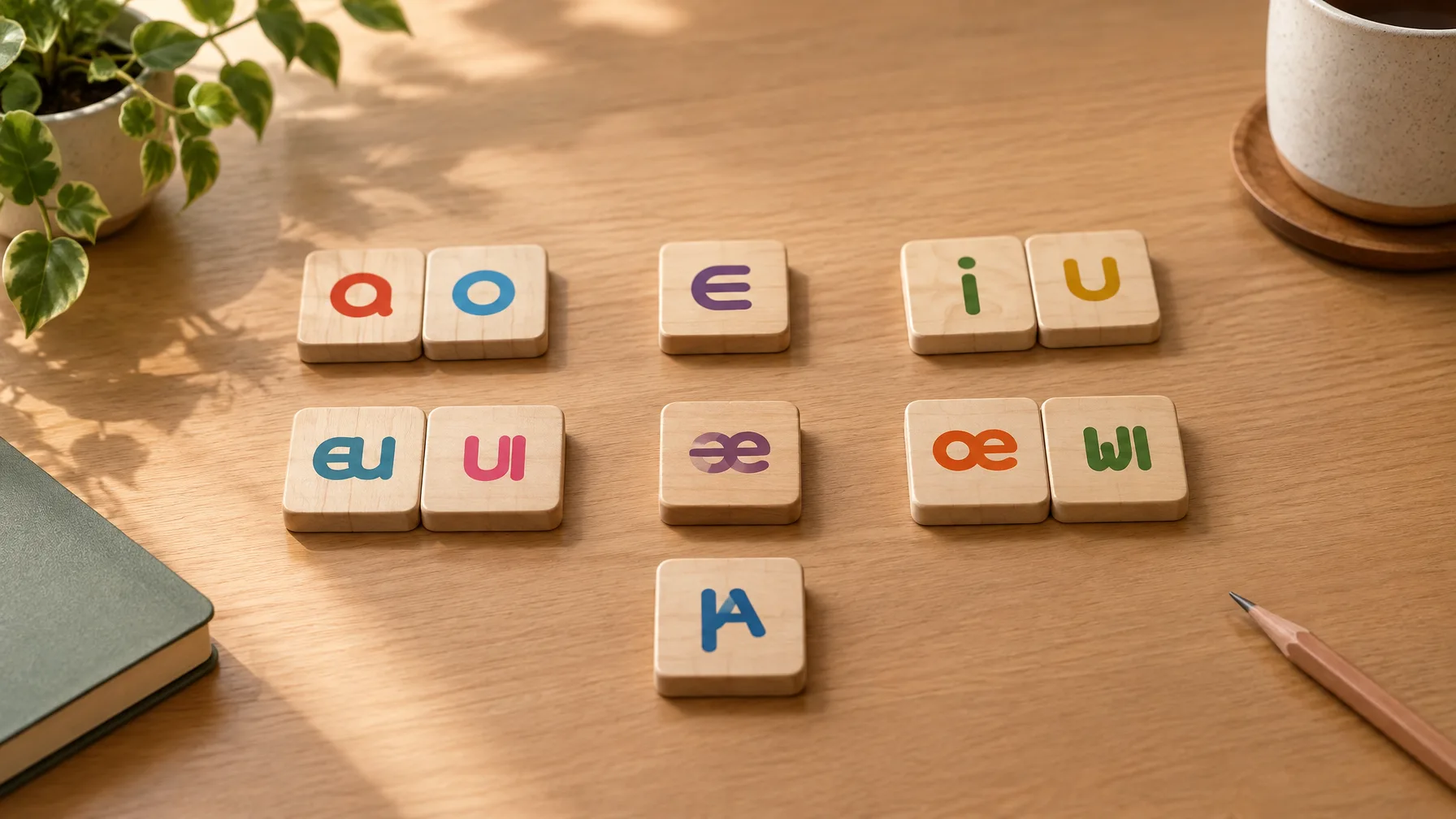
A combined vowel is just two basic vowels joined into one letter. There are eleven of them, and the useful way to learn them is by sound rather than by spelling. Think of the table below as a Korean vowels chart you can save to your phone.
| Letter | Romanization | Sound group |
|---|---|---|
| ㅐ | ae | Same as ㅔ |
| ㅔ | e | Same as ㅐ |
| ㅒ | yae | Same as ㅖ |
| ㅖ | ye | Same as ㅒ |
| ㅙ | wae | Same as ㅚ and ㅞ |
| ㅚ | oe | Same as ㅙ and ㅞ |
| ㅞ | we | Same as ㅙ and ㅚ |
| ㅘ | wa | Its own sound |
| ㅝ | wo | Its own sound |
| ㅟ | wi | Its own sound |
| ㅢ | ui | Its own sound |
In everyday speech, those eleven letters boil down to about seven sounds. Most Korean native speakers can no longer hear the tiny gap between ㅐ and ㅔ, so you can treat them as one sound.
The catch is spelling. Since several letters share a sound, you have to memorize which letter goes in which word. The basic ten have a chant-like order that helps. The combined ones have no easy rhythm, so they take longer to stick. Expect to see them many times before they feel natural.
English sounds get you close on the basics, then run out
Korean vowel pronunciation is steadier than English. Learners often find that this makes vowels a little easier to speak than consonants.
| Letter | Closest English sound | Where the comparison breaks |
|---|---|---|
| ㅏ | 'ah', the a in 'car' | Romanization 'a' tempts you toward the a in 'cat' |
| ㅓ | u in 'cup' or 'under', o in 'love' | The spelling 'eo' looks like none of these |
| ㅗ | o in 'bow' | Easy to blur with ㅓ, since both sound like an English o |
| ㅜ | u in 'boots' | The letter 'u' tempts you toward 'uh' |
| ㅡ | The groan of a ghost or zombie | No clean English match |
| ㅣ | The 'ee' in 'see' | The letter 'i' tempts you toward 'eye' |
| ㅑ ㅕ ㅛ ㅠ | The matching plain vowel with a quick 'y' in front | The y glide should stay light and short |
Treat these comparisons as a starting point. Many Korean vowel sounds don't match English ones, and at least seven English vowels don't exist in Korean at all. A table can't replace the real thing, so listen to a native speaker, and keep listening.
ㅢ, ㅚ and ㅓ versus ㅗ are where beginners slip
ㅢ is the vowel to watch most. It has three readings: [ui] at the start of a word, [i] in the middle of a word, and [e] when it marks possession. It is also not the same as ㅟ. For ㅟ you round your lips and say [wi]. For ㅢ you keep your mouth spread wide and say [ui].
ㅚ is the hardest of its sound group for English speakers. The romanization 'oe' makes you think of a plain o, which is the wrong target. And ㅓ versus ㅗ is a classic mix-up. Both sound like an English o, but ㅓ sits closer to the o you already know. Some learners also say the two letters O and U are hard to tell apart.
Two more spelling traps are worth knowing before you start reading real text:
- ㅖ often sounds like [e] after any consonant except ㄹ, so reading it as [ye] can be wrong.
- ㅝ in the middle of a word is usually pronounced like ㅓ, so reading it letter by letter can be wrong.
A vowel never stands alone in a block, so placement matters
Every Korean syllable needs at least one consonant and one vowel. That is why Korean vowels and consonants always travel together in a square block. When a syllable starts with a vowel sound, a silent ㅇ takes the consonant slot.
Placement depends on the vowel's shape. Upright vowels like ㅏ, ㅣ and ㅐ go to the right of the consonant. Flat vowels like ㅗ, ㅜ and ㅡ go underneath. Some combined vowels partly wrap around the consonant. They are a bit trickier to place than the simple side-or-below rule.
| Block | Consonant | Vowel | Where the vowel sits |
|---|---|---|---|
| 가 | ㄱ | ㅏ | Right of the consonant |
| 개 | ㄱ | ㅐ | Right of the consonant |
| 고 | ㄱ | ㅗ | Below the consonant |
| 그 | ㄱ | ㅡ | Below the consonant |
| 아 | Silent ㅇ | ㅏ | Right of the silent ㅇ |
Learn the ten, add the eleven, and keep your ears open
Start with the 10 basic vowels, ㅏ ㅑ ㅓ ㅕ ㅗ ㅛ ㅜ ㅠ ㅡ ㅣ. Then learn the 11 combined ones, knowing that ㅐ and ㅔ, ㅒ and ㅖ, and ㅙ, ㅚ and ㅞ sound alike. English comparisons only get you part of the way, so check each vowel against a native speaker's audio. Take it one small group at a time.
Comments
No comments yet.