
How Old Is 14 in Korean Age? A Year or Two Older
 AI-generated image
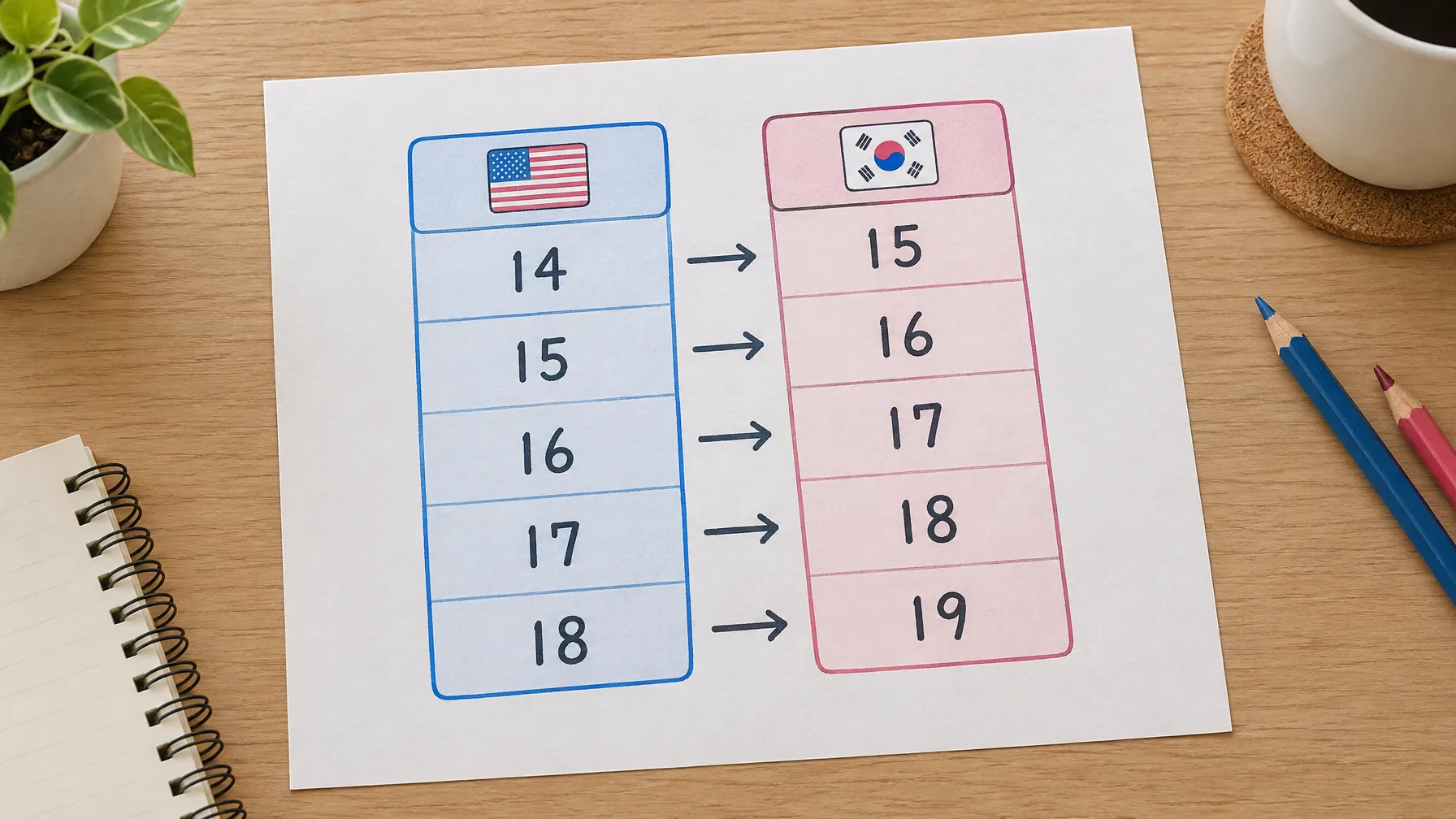
How old is 14 in Korean age? If you are 14 by international age, you are 15 or 16 in Korean age. That's because Korean age counts you as 1 at birth, and everyone adds a year on January 1. Someone who says they are 14 in Korean age is 12 or 13 by international age. The gap is one year or two, never a fixed number. In Korean, 14 years old is yeolle sal (열네 살).
International 14 becomes 15 or 16 in Korea
 AI-generated image
International age is the one most Americans use: you start at 0 and go up on each birthday. Korean age always runs ahead of it. Below is the two-way lookup for 14, which you can read from either side.
| You know this age | Korean age | International age |
|---|---|---|
| International 14 | 15 or 16 | 14 |
| Korean 14 | 14 | 12 or 13 |
Which of the two numbers is yours depends on your birthday, and the next two sections show how.
Korean age starts at 1 and moves with the calendar
 AI-generated image
Korean age is a way of counting, not a different way of growing up. A baby is already 1 at birth. The number goes up for everyone on the same day, January 1, and not on a birthday. International age starts at 0 and rises on each birthday. So the two systems drift apart and then partly close again during the year.
The Korean age formula needs only a birth year: current year minus birth year, plus 1. Someone born in 2000 is 27 in Korean age for all of 2026. You don't need a month or a day, and that's what makes the formula quick to use.
Why one 14-year-old gets two possible answers
 AI-generated image
Put the two together and the gap changes during the year. After your birthday it is one year. Before your birthday it is two.
Picture two people who are both 14 by international age. One was born early in the year and has already had a birthday this year. That person is 15 in Korean age. The other was born a year earlier in the calendar and still has a birthday coming. That person is 16.
The reverse works the same way. Someone who is 14 in Korean age is 13 by international age if the birthday has passed, and 12 if it hasn't. People born in the same year share a Korean age. Two friends from the same birth year always match, even when their international ages differ.
Say it as yeolle sal (열네 살)
To say 14 years old in Korean, you'd say yeolle sal (열네 살). Notice that the phrase gives only a number, with no label for which system you mean.
If a Korean person asks your age and you are not sure which one they want, give your birth year. The formula will settle the question for both of you.
Passports and legal limits use international age
Official documents such as passports and birth certificates use international age, not Korean age, and so do the legal age limits for alcohol, cigarettes, and driving.
Everyday talk is where Korean age lives. Many Koreans, though, ask foreigners for international age to avoid confusion. The calculation is not intuitive for Westerners, and it is easy to mix the two up.
13, 15, and 16 shift by the same one or two years
The same one-or-two-year rule applies to every nearby age, such as 13 or 15. The answer depends on which age you start from, and the table below reads both directions.
| Starting age | If this is international age, Korean age is | If this is Korean age, international age is |
|---|---|---|
| 13 | 14 or 15 | 11 or 12 |
| 15 | 16 or 17 | 13 or 14 |
| 16 | 17 or 18 | 14 or 15 |
Slips that throw the conversion off
- Adding exactly one year. Korean age is one or two years above international age, so a flat +1 is wrong about half the time.
- Thinking Korean age changes on your birthday. It changes on January 1 for everyone.
- Using the formula to find international age. It returns Korean age only, and international age needs the birthday as well.
- Writing Korean age on official papers. Passports and birth certificates want international age.
- Assuming a Korean person means Korean age when talking to you.
Comments
No comments yet.